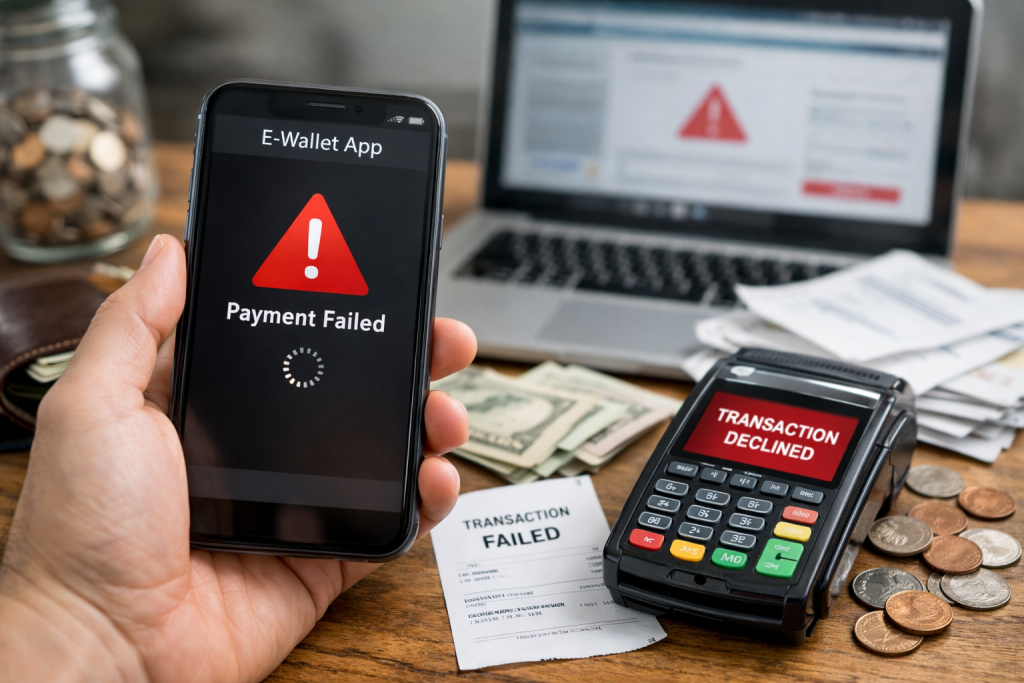





Picture this: you’re at the checkout counter, groceries piled up, people behind you in line, and your e-wallet app just refuses to load. No explanation. No warning. Just a spinning circle or a vague error message staring back at you. It’s one of those moments that makes your heart sink a little, especially when you’re counting on digital payments to get through your day.
If this has happened to you, you’re not alone. Millions of people worldwide rely on e-wallets for everything from buying coffee to paying rent. So when something goes wrong, the first question that pops into most people’s heads isn’t “how do I fix this?” – it’s “where did my money go?”
Good news – it didn’t go anywhere. Let’s break down exactly what’s happening behind the scenes and what you should do about it.
E-Wallet Outages Happen Everywhere
Digital payment disruptions aren’t unique to any one country or platform. They happen worldwide – from Europe to North America to Southeast Asia. In fact, some of the most active digital payment communities in the world regularly deal with this.
Take the Philippines, for example. It’s one of the fastest-growing digital payment markets in Asia, with tens of millions of people using apps like GCash for everyday transactions. When these platforms experience e-wallet downtime, it affects daily life on a massive scale – from paying bills to sending money to family members across the country. It’s a pattern that plays out similarly in markets around the world, and it’s a good reminder that no matter where you are, having a backup plan is always worth it.
Your Money Is Still There – Here’s Why
A lot of people assume that if the app isn’t working, their money is somehow at risk. That’s a completely understandable reaction, but it’s not how digital finance works.
When you load money into an e-wallet, those funds are stored on the company’s secure servers – not locally on your device. Think of the app as just a window into your account. When that window fogs up or cracks, the room behind it is still perfectly intact. The servers that hold your balance keep running even when the app-facing side of things breaks down.
So whether it’s a scheduled maintenance window or an unexpected system hiccup, your balance is safe. The app being down just means you temporarily can’t access it – not that it’s gone.
What Actually Happens to Your Transactions
This is where things get a little more nuanced – especially if you were mid-transaction when the app stopped working.
When an outage hits during a payment or transfer, that transaction usually lands in one of two states. Either it completes successfully once the system recovers, or it gets automatically reversed and the funds return to your wallet. Both outcomes are normal, and both are handled on the backend without you needing to do anything.
The tricky part is the waiting. Depending on the severity of the outage, this process can take anywhere from a few minutes to 48 hours. Not ideal when you’re waiting on an urgent transfer – but it does sort itself out.
One thing worth knowing: if you see a transaction marked as “pending” for longer than 48 hours after the system is back up, that’s when it makes sense to reach out to customer support directly.
First Things to Check Before You Panic
Before assuming there’s a widespread outage, run through these quick checks. Sometimes the problem is closer to home than you think.
- Check your internet connection. Switch from Wi-Fi to mobile data or vice versa. A weak signal can mimic app errors surprisingly well.
- Force close and reopen the app. Simple, but it works more often than you’d expect. Close it completely, wait a few seconds, then relaunch.
- Look for app updates. An outdated version can cause all sorts of glitches. Check your app store for any pending updates.
- Clear the app cache. Android users can do this through their phone settings. It clears out temporary data that sometimes causes the app to behave strangely.
If none of these fix the issue, it’s likely a server-side problem – meaning it’s on the company’s end, not yours.
How to Confirm It’s a Real Outage
The fastest way to confirm a widespread issue is to check the e-wallet’s official social media pages. Most companies post real-time updates on Facebook or X (formerly Twitter) whenever there’s a service disruption. The comments section on their latest posts is also a good indicator – if hundreds of people are reporting the same problem, you have your answer.
News sites and tech blogs also tend to pick up major outages quickly. A quick Google search usually tells you everything you need to know within seconds.
What to Do When You Need to Pay Right Now
Sometimes an outage hits at the worst possible time and you genuinely can’t wait it out. Here’s how to handle urgent payments when your primary app is down:
- Use a secondary e-wallet: Having a backup app already installed and verified means you’re never completely stuck. Keep a small balance there for exactly these situations.
- Switch to online banking: Most banks have apps that support instant transfers through local payment networks. These operate independently of e-wallet systems and are typically unaffected by platform-specific outages.
- Pay in cash: It’s old school, but it’s reliable. Keeping a small amount of physical cash on hand is still one of the smartest financial habits you can have – regardless of where you live.
How to Avoid Getting Caught Off Guard Next Time
Outages are unpredictable – there’s no way to completely avoid them. But you can absolutely prepare so they don’t derail your day.
Set up at least one backup payment option. Whether it’s a secondary e-wallet, an online banking app, or just a bit of cash tucked away, having alternatives means an outage becomes a minor inconvenience rather than a crisis. It takes maybe 10 minutes to set up and it’s worth every second.
Also, follow your primary e-wallet’s official social media accounts. Being the first to know about an outage means you can pivot faster and avoid the frustration of repeatedly trying an app that won’t respond.
Bottom Line
App outages are a reality of living in a digital-first world. They happen across every market, every platform, and every country – no one is immune. But they’re almost never a reason to panic about your money. Your funds are safe, your pending transactions will resolve, and the app will come back online.
The smartest thing you can do is stay calm, run through the basic troubleshooting steps, and have a backup plan ready for when you really need it. A little preparation goes a long way when technology decides to take an unscheduled break.